Employees of Latvijas Finieris learn how to fly unmanned aircraft
05.06.2026
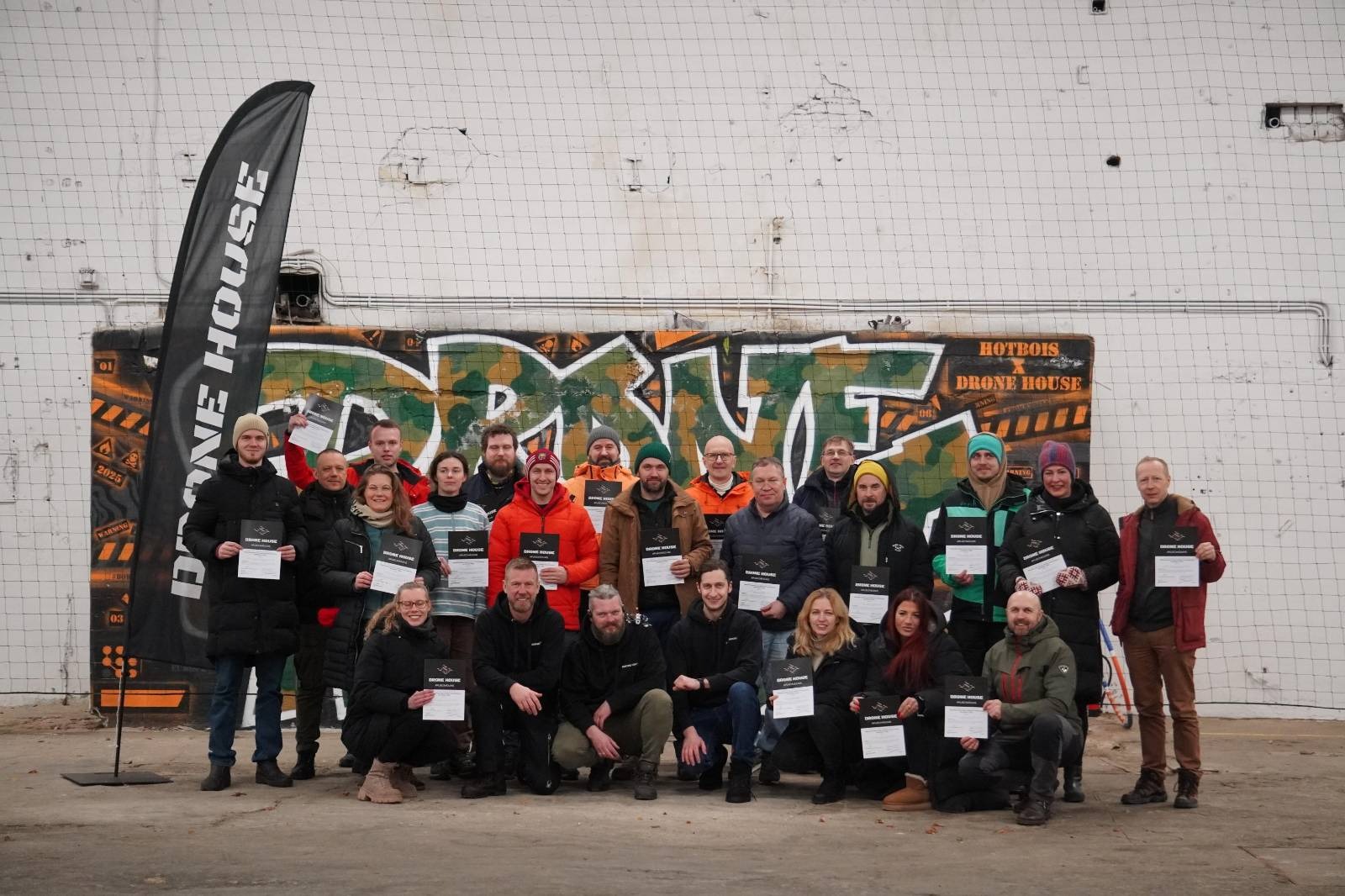


In order to strengthen employee competencies, raise awareness of new technologies, and improve safety knowledge, 18 employees of Latvijas Finieris, the second group this year, have successfully completed the micro-class unmanned aircraft operator course organised by.
During the training, participants learnt the basic principles of unmanned aircraft use, the regulatory framework and safety requirements, as well as gained practical experience in drone control. The training programme included theoretical lessons, simulator work, and practical flights in real conditions.
Kristaps Vucāns, Member of the Board of Drone Force Europe and Drone House, points out:
“This is a topic that is becoming increasingly important. Drones are no longer the future – they are the reality of today, and the safety of us all is directly linked to how skilfully and responsibly we handle them and what we know about them. The more people understand the processes and the technical side, the better and safer it will be for everyone.
Seeing how quickly participants go from first attempts to confident drone control makes the investment in staff competence pay off and raises awareness of potential risks. The higher our overall technical culture, the safer the environment around us. I encourage other companies not to wait and to start investing in their teams’ understanding of unmanned aircraft technology now – comprehensive knowledge and skills regarding the world of drones is fast becoming a standard!”
Inese Ruskule, office administrator at Latvijas Finieris, also talks about her experience:
“When I applied for the “Micro Class Unmanned Aircraft Operator Course” offered by Latvijas Finieris, I had no experience in working with drones. I wanted to learn new skills, but I gained much more knowledge. For four years now, a war has been fought near our country, where life is unthinkable without the use of drones. They are used for both military and civilian applications. In addition to drone control practice, the training also provided valuable insights into dealing with emergencies and the first few days of a crisis.
Initially, flying a drone was not easy, as you had to start from scratch. However, thanks to the professional teachers and instructor, Māris Akuls, the basic skills were successfully acquired. I am grateful to Latvijas Finieris for the opportunity to participate in this high-level training.”
Evija Pētersone, Director of HR Service at Latvijas Finieris, emphasises:
“This training is the company’s contribution to developing employee competencies, technological literacy, and safety. In today’s dynamic environment, the ability to understand and use new technologies responsibly is becoming increasingly important. Our aim is to create an environment where employees not only develop their professional skills but also acquire knowledge that strengthens their ability to deal with different situations and contributes to the overall resilience of society.
We can see that there is a great interest in this training, so this year, another group of Latvijas Finieris employees will have the opportunity to acquire theoretical knowledge and practical skills in controlling unmanned aircraft.”